Creating a New Experience for Symcor’s Change Request Process: From Discovery to Validation
Problem
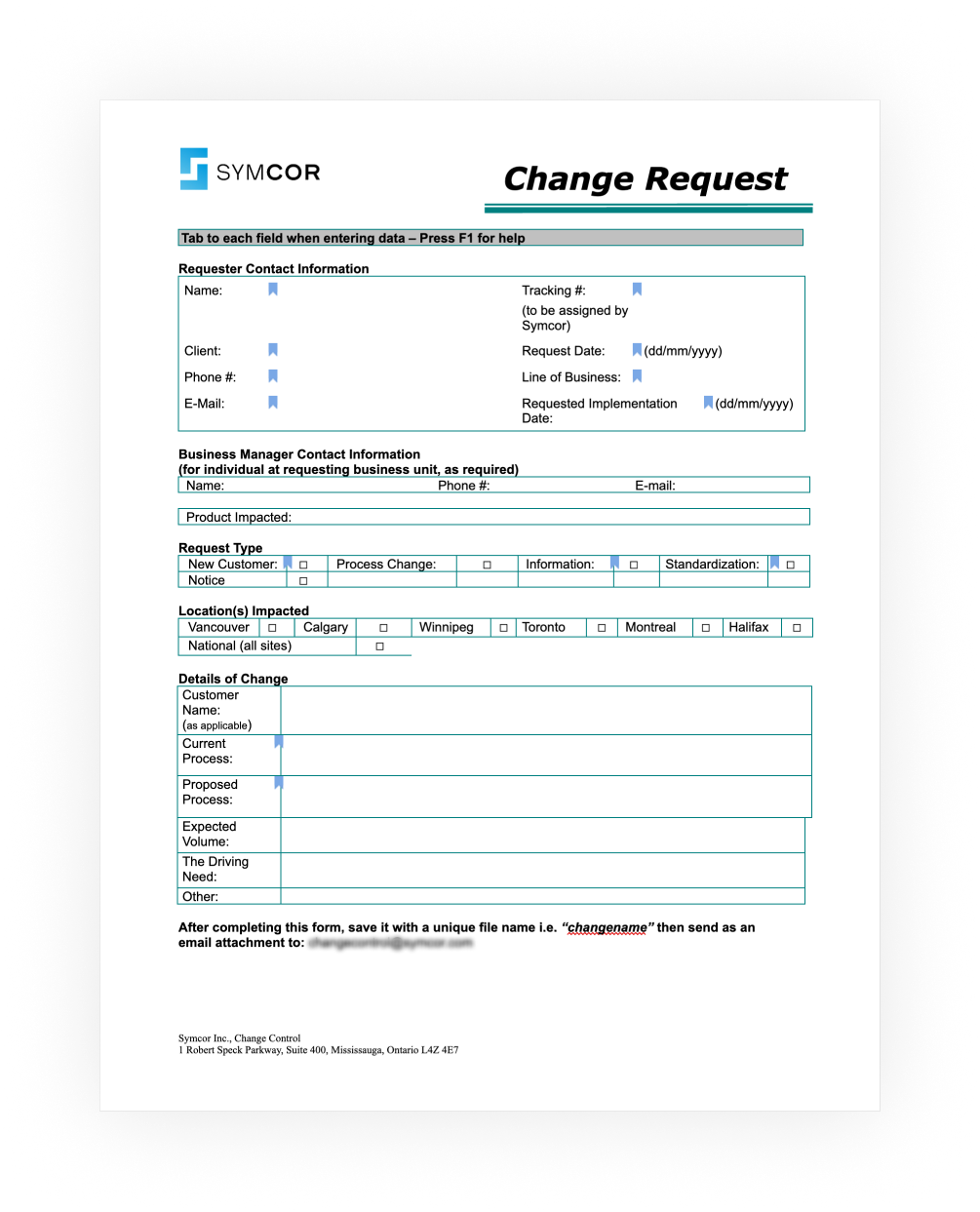
The existing change request process was fragmented and heavily reliant on emailing with word documents.
Approach
Human-centered design, extending beyond Symcor’s clients to include the internal teams who deliver and support the service.
Solution
A client web portal that transformed the change request process into a streamlined digital experience.
Context
Symcor is a leading Canadian business process outsourcing (BPO) provider delivering payment processing, customer communications, and digital transformation services for major financial institutions, including BMO, TD, Scotiabank, RBC, and 100+ others across Canada.
When a client needs something changed, they email Symcor and fill out a form in word doc.
The Journey Begins
Diagnosing the Current-State Experience
While the six-week timeline could have pushed us straight into ideation, this problem required a deeper understanding of the people and processes involved. We started with stakeholder interviews and existing research to ensure our design decisions were grounded in evidence.
Stakeholder Interviews
3 interviews w Change Leads
3 interviews w Client Success Managers
Previous Research Data
Research Report
Client Satisfaction Survey
Anecdotal User Insights
💡 Data Synthesis
While interviews revealed underlying pain points and workflow challenges, quantitative data validated these findings at scale.
Synthesizing both sources provided a well-rounded view of the problem space, helping to uncover recurring themes, confirm assumptions, and prioritize opportunities with greater confidence.
From Data to Clarity
The Humans Behind the Complexity
Stakeholder interviews uncovered a complex ecosystem involving multiple parties, each playing a distinct role in the change request process. To establish a shared understanding, stakeholder roles, goals, responsibilities, and touchpoints were mapped, revealing how each party interacted within the broader change request ecosystem.
Commercial Client
Canadian Tire
“I need to submit a change request quickly and know it will be handled correctly the first time.”
Goals:
Submit change requests easily
Clear visibility into request status
Minimal back-and-forth with Symcor
Pain Points:
Generic forms that don’t fit their needs
Unclear timelines and ownership
Long email threads for clarification
Change Lead
Symcor
“I can’t begin scoping until complete submissions are clarified.”
Goals:
Complete, structured submissions
Faster scoping and evaluation
Clear request history
Pain Points:
Incomplete or unclear requests
Repeated clarification cycles
Delayed project starts
Client Success Manager
Symcor
“I spend too much time guiding clients through a form that should be self-serve.”
Goals:
Clients submit complete requests
Fewer manual follow-ups
Centralized request tracking
Pain Points:
Coaching clients through forms
Scattered communication channels
No single view of active requests
Research Insights
Systemic Sources of Friction for each:
Clients struggled with generic forms, fragmented communication, and lengthy turnaround times.
CSMs spend their time guiding clients through a form that should be self-serve.
Change Leads can’t begin scoping until complete submissions are clarified.
Repeated clarification cycles extended the review process and created growing email threads, compounding inefficiencies and friction for both clients and internal stakeholders.
The Problem
The journey was shaped by a series of interconnected challenges that created obstacles and setbacks for everyone involved.
Clients struggled with request submissions, fragmented communication, and limited visibility, while internal teams spent significant time gathering information and managing follow-ups.
These inefficiencies compounded over time, creating delays and friction for all stakeholders.
How Might We
Framing the Right Problem for each:
When working with cross-functional teams, it’s easy to get caught up in different perspectives and individual challenges, which can sometimes cause us to lose sight of the core problem we’re actually trying to solve. To work through each layer of complexity, I like using “How Might We” (HMW) questions to frame and define the problem at each stage. This approach helps me and stakeholders across teams build a shared understanding of the broader problem space, while creating greater clarity around the specific challenges we need to address.
For Clients
How might we streamline the change request process for clients to ensure smooth onboarding, tracking, and approval?
For Change Leads
How might we streamline the change request process for Symcor’s clients to ensure a smooth end to end experience for submitting, tracking, and approving Change Requests?
For Client Success Managers
How might we help client success managers and stakeholders submit and follow up on change requests in an efficient manner?
Experience Mapping
Narrowing the Focus: The Client Journey
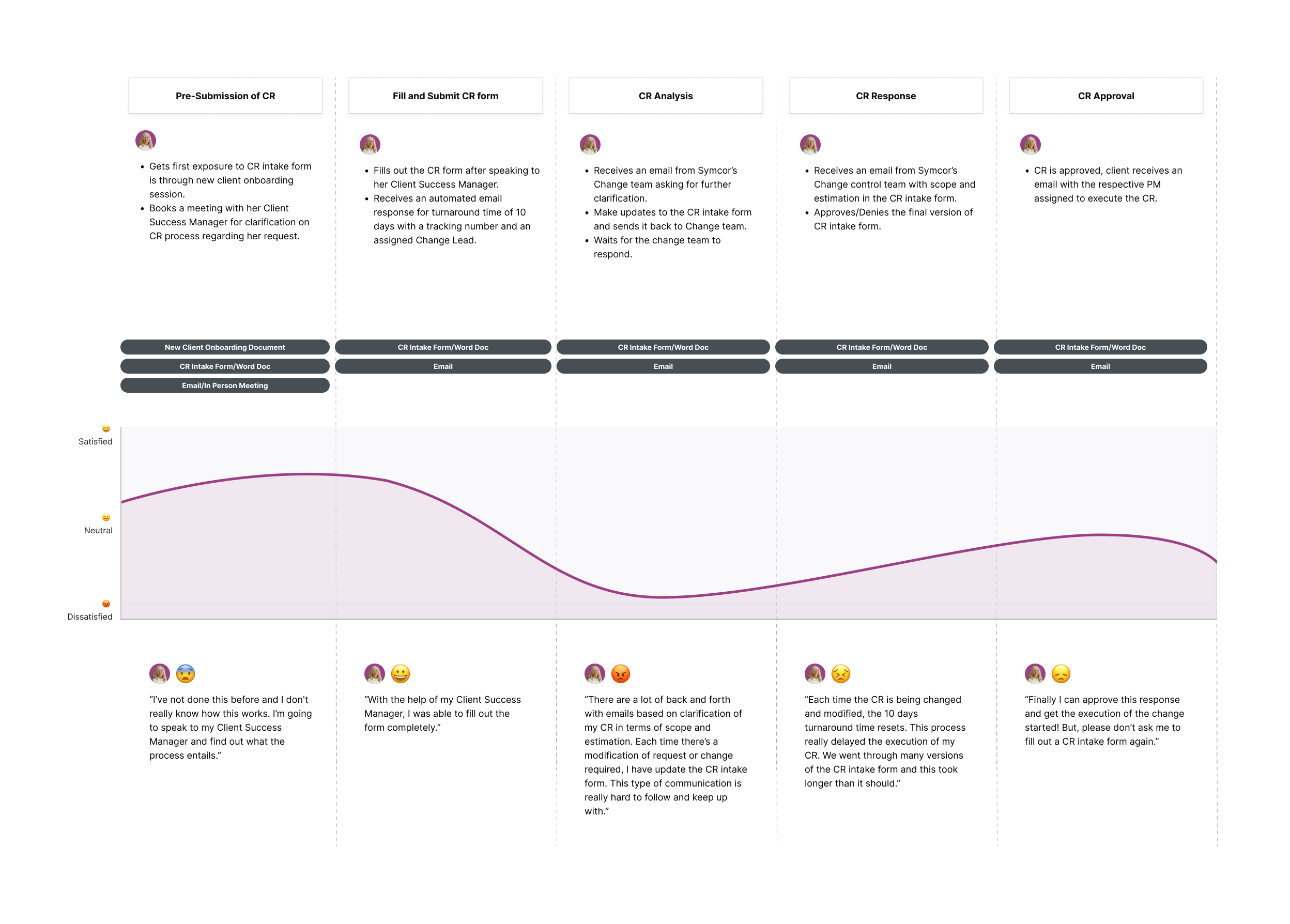
While the change request process involved multiple roles and dependencies, the project focused on the end-user journey to address the most immediate sources of friction for Symcor’s clients.
The experience map highlighted key pain points from initial CR submission through hand-off, providing a clear foundation for prioritizing improvements.
Strategic Solution Exploration
Balancing Impact and Feasibility
Based on client priorities, budget, and development considerations, a range of solution concepts were explored to identify the right balance between user value and feasibility.
Solution
UX Impact
Technical Effort
Features
Value Proposition
Digital Form
Medium ⚡
Low 🟢
Unified CR intake form, standardized information collection.
Reduces submission friction by standardizing intake.
Client Portal Lite
Med – High ⚡
Med 🟡
Request tracking, template access, with some self-service capabilities.
Improves visibility and self-service by allowing users to track requests.
Addresses multiple pain points across the entire journey: submission, tracking, approvals, communication, and transparency.
AI Concierge
?
Med – High 🟡🔴
AI-guided submission experience, conversational form intake and troubleshooting.
Could significantly improve submission quality, reduce clarification cycles and form complexity, but impact depends on AI accuracy and adoption.
🌟 Chosen Solution
Client Portal Pro
While the most comprehensive solution may not always be the most feasible due to budget, technical constraints, or implementation effort, it was important to demonstrate what an ideal future-state experience could look like.
To help stakeholders visualize the full potential of a transformed change request ecosystem, detailed proof-of-concept designs were created for a comprehensive client portal, showcasing how key pain points could be addressed through a connected, end-to-end experience.
Wireframes
Bringing the Vision to Life
Testing
From Concept to Confidence
Three concept testing sessions were conducted with end users from Symcor’s banking clients, with recruitment and facilitation support provided by Symcor’s Client Success Managers. The sessions helped validate key assumptions, gather user feedback, and assess the overall value and usability of the proposed experience.
Area Tested
Key Feedback
CR Submission Form
• Need client-specific form flexibility • Improve required field clarity • Reuse past CR information • Capture missing details upfront
Status Tracking & Workflow Visibility
• Need clearer progress stages • Define ownership between client and Symcor • Show response timelines and pending actions
• Multiple contributors involved per request • Need visibility into updates • Support different user responsibilities
Form & Approval Experience
• Complex forms need simpler layouts • Approval process needs structure
High Fidelity Designs
The Transformed Experience
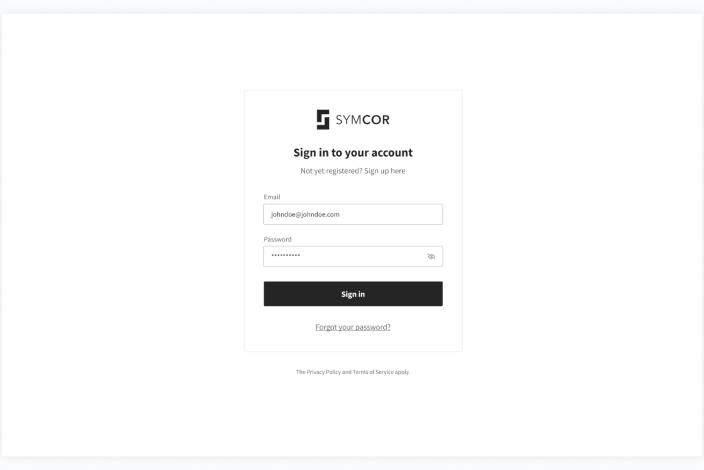
The full client portal reimagined the entire change request experience by digitizing submission, review, approval, and tracking workflows within a single platform.
Key features included dynamic request templates, status tracking, consultation scheduling, centralized dashboards for managing active and completed requests, draft saving, and request archiving, providing greater transparency, efficiency, and self service for all stakeholders.
Video Walkthrough
Personalized at Scale
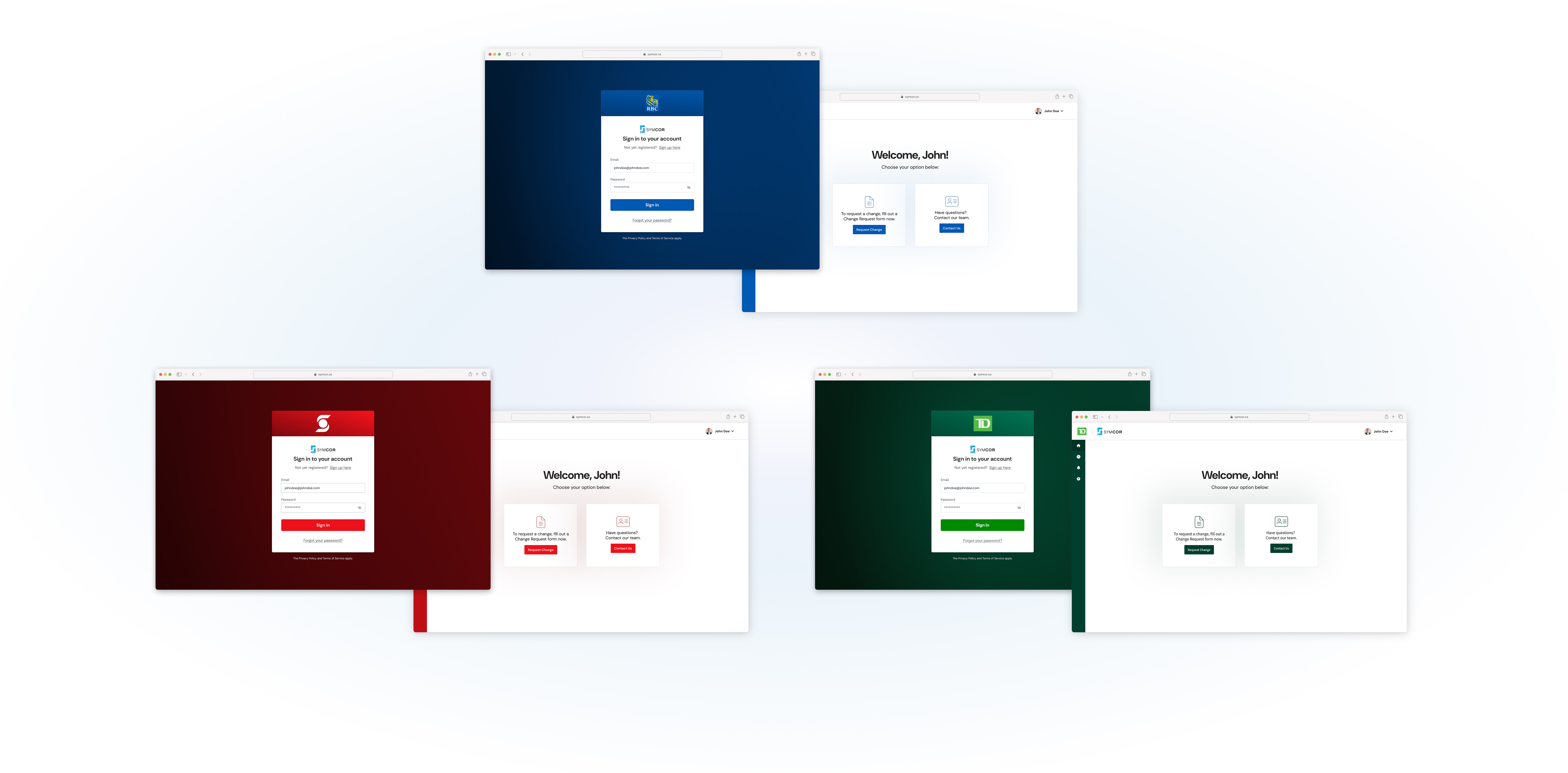
Brand Agnostic by Design
Although the platform was designed as a single scalable solution, its visual identity can be adapted to align with each financial institution’s brand. To demonstrate this flexibility, four branded concepts were created for Symcor’s major shareholder banks, illustrating how the same experience can feel familiar to different clients while maintaining one underlying product.
Projected Outcome
Envisioning the Future Impact
While the portal remains a proof of concept, projected outcomes were defined to demonstrate its potential value for Symcor’s clients and internal teams.
End User/Client Impact
60%Reduced Turnaround TimeFrom an average of 8.5 days to 2.1 days per change request — a 60% improvement.
40%Reduction in Email ExchangesCentralized communication, structured submissions, and status tracking reduce repetitive follow-ups and clarification threads.
Business Impact
30%Faster CR ScopingBetter submission quality and structured request details allow Change Leads to begin evaluation sooner.
4+Hours/Week SavedReduced escalation management and manual status chasing allows CSMs to focus on client relationships.
Future Thinking
From Concept to Ecosystem
The current proof of concept focuses on the client-facing experience, but bringing the concept to life would require designing the experience across all three user roles. This includes defining how Change Leads and Client Success Managers would interact with the portal, manage requests, and support clients behind the scenes—creating a connected experience across the entire change request ecosystem.